
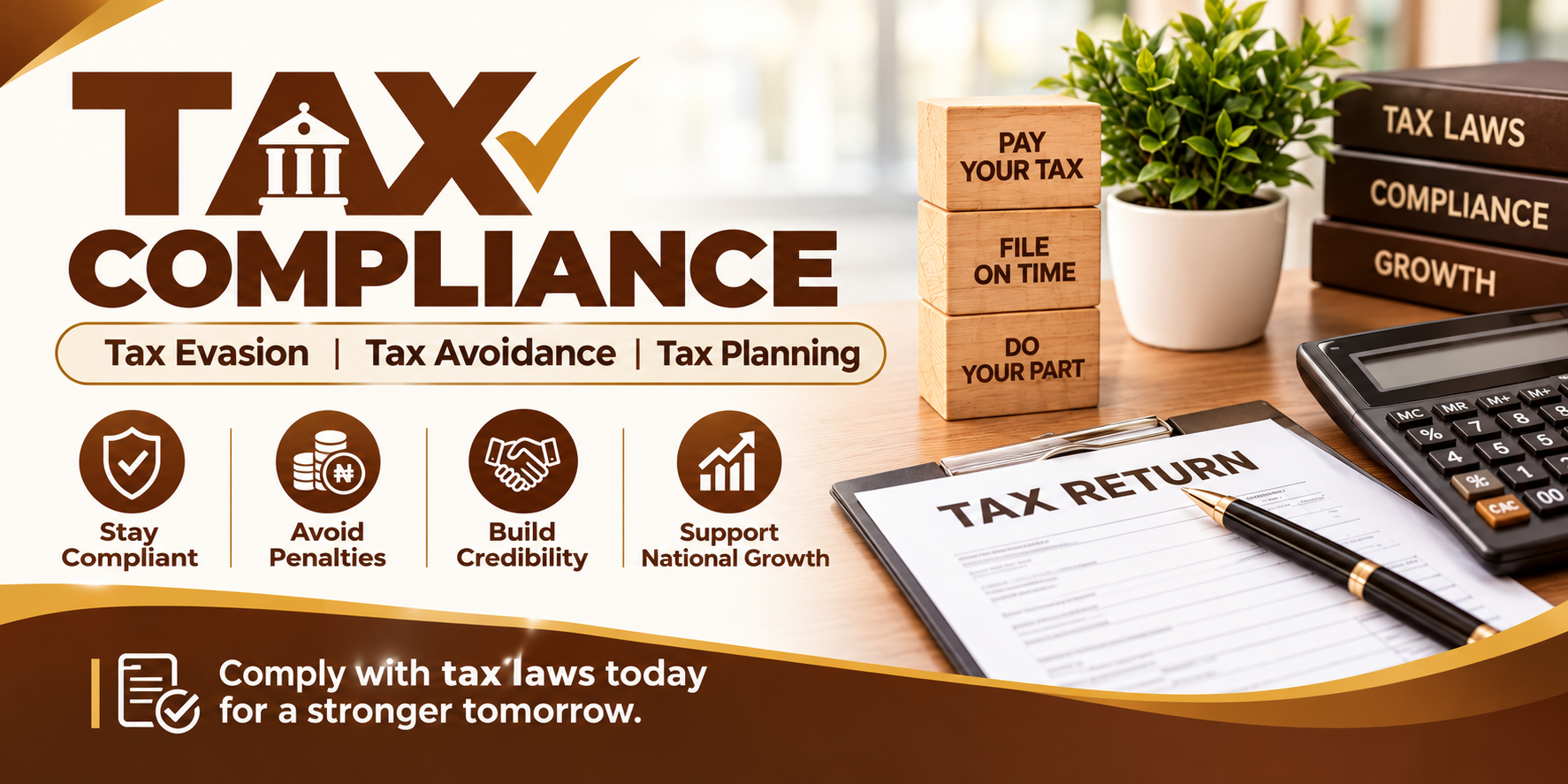
The Net Is Closing: Tax Evasion, Tax Avoidance and Why Compliance Is Your Smartest Move

For taxpayers at home in Nigeria and Nigerians living abroad
The Day the Secret Stopped Being Secret
For years, some taxpayers lived by a quiet assumption: "No one will ever find out." Income went undeclared. Foreign accounts stayed unmentioned. A clever gap in the law seemed like a permanent door left open.
That world is disappearing. Tax authorities now use data, technology and international cooperation to see what was once invisible. The question has changed. It is no longer "Does the tax authority know today?" It is "Can my tax affairs withstand scrutiny tomorrow?"
This article explains what tax evasion and tax avoidance really mean, why the loopholes are closing, and what every Nigerian taxpayer, at home or abroad, should do about it.
First, the Definitions
These terms are often mixed up. The differences matter legally and financially.
- Tax compliance: Meeting all your tax obligations: registering, filing accurate returns on time, keeping records and paying what is due.
- Tax planning: Organising your finances in a lawful way, using reliefs, exemptions and deductions the law intends you to use, to pay no more tax than you legally owe.
- Tax avoidance: Arranging transactions to reduce tax in ways that technically follow the law but may defeat its purpose. Avoidance is not automatically illegal, but aggressive schemes can be challenged and unwound.
- Tax evasion: Deliberately breaking the law to pay less tax, for example hiding income or assets, falsifying records, inflating expenses or failing to file. Evasion is a crime.
- Loophole (lacuna): A gap, ambiguity or weakness in tax law that people exploit to reduce tax in ways lawmakers never intended.
- Anti-avoidance rule: A legal provision that lets tax authorities disregard or recharacterise arrangements whose main purpose is to obtain a tax advantage.
- Tax residence: The country (or countries) that treats you as a resident for tax purposes. It is decided by each country's rules, not by where you feel at home.
- Double taxation: Being taxed on the same income by two countries. Double taxation agreements (DTAs) exist to relieve this.
- Automatic exchange of information (AEOI) / Common Reporting Standard (CRS): International arrangements under which participating countries share financial account information about each other's residents.
- Offshore account: A bank or investment account held outside your country of residence. Holding one is not illegal. Failing to declare income or assets linked to it where required can be.
Evasion vs. Avoidance: A Simple Picture
Imagine two people with the same income.
The first uses every legitimate relief, keeps clean records and pays exactly what the law requires. That is tax planning.
The second builds a complicated structure whose main purpose is to shrink the tax bill, with little real business reason behind it. That is avoidance, and it is increasingly in the sights of regulators.
The third simply doesn't declare income and hopes nobody checks. That is evasion, and it is where the heaviest consequences live.
The line between the second and third can be thinner than people think. What looks like a clever structure today can be recharacterised tomorrow.
Why the Loopholes Are Closing
Three forces are working together.
1. Reform of the law. Governments keep updating tax legislation and strengthening anti-avoidance provisions to close gaps once exploited.
2. Technology and data. Digital filing, data analytics and third-party information (from banks, employers, registries and other agencies) make mismatches far easier to spot. A lifestyle that doesn't match declared income is a red flag.
3. International cooperation. Countries now share information. Money moved across borders no longer disappears from view. Offshore accounts and cross-border structures are not automatic shields.
Home Front: What Nigerian Taxpayers Should Know
Nigeria's tax system is modernising. Administration is increasingly digital, and authorities have more ability to reconcile what you declare with what other sources report. That means:
- Register properly and keep your tax identification details current.
- File accurate returns on time, even when no tax is payable, where filing is required.
- Keep invoices, receipts and records that support every figure.
- Don't assume a small business is too small to be noticed.
Diaspora Alert: Living Abroad Doesn't Settle Everything
Many Nigerians abroad assume that leaving the country ends their Nigerian tax story. It may not. Questions to ask:
- Where am I tax resident? You can have obligations in more than one country.
- Where is my income sourced? Rental income from Nigerian property, a Nigerian business, dividends or remote work can raise Nigerian tax questions.
- Is there a tax treaty? DTAs can prevent you paying twice, but you must claim relief correctly.
- What do I owe in my country of residence? Foreign countries often tax worldwide income and require disclosure of overseas assets.
Rules differ by country and by individual situation, so take professional advice rather than relying on assumptions or what a friend did.
Five Dangerous Myths
- "The tax authority doesn't know." Data sharing makes this less true every year.
- "I live abroad, so it doesn't apply to me." Residence, source of income and treaties decide this, not distance.
- "The money is outside Nigeria." Offshore does not mean invisible.
- "My business is too small." Size doesn't remove obligations.
- "Everyone does it, and there's a loophole." A loophole today can become a liability tomorrow, sometimes retrospectively challenged.
The Real Cost of Non-Compliance
The tax owed is only the beginning. Non-compliance can bring:
- Back taxes and reassessments
- Interest and penalties that compound the problem
- Audits and investigations that consume time and money
- Damage to reputation, banking relationships and business opportunities
- Criminal consequences where deliberate evasion is established
Your Compliance Checklist
- Register correctly
- File accurate and timely returns
- Keep complete records
- Declare all relevant income and transactions
- Use reliefs, exemptions and deductions the law actually allows
- Get professional advice for complex or cross-border affairs
- If you've fallen behind, ask a qualified adviser about regularising your position before the authorities come to you
The Law Is Catching Up
Tax laws evolve. Technology sharpens enforcement. Borders are becoming transparent. A gap that seems safe today may offer no protection tomorrow.
The smartest financial decision isn't finding the cleverest loophole. It's building tax affairs you never have to worry about.
The question is no longer whether the tax authority knows today. The real question is whether your tax affairs can withstand scrutiny tomorrow.
Disclaimer: This article is for general information only and is not tax or legal advice. Tax rules vary by country and personal circumstances. Consult a qualified tax professional for your situation.


Comments (3)
Leave a Comment